
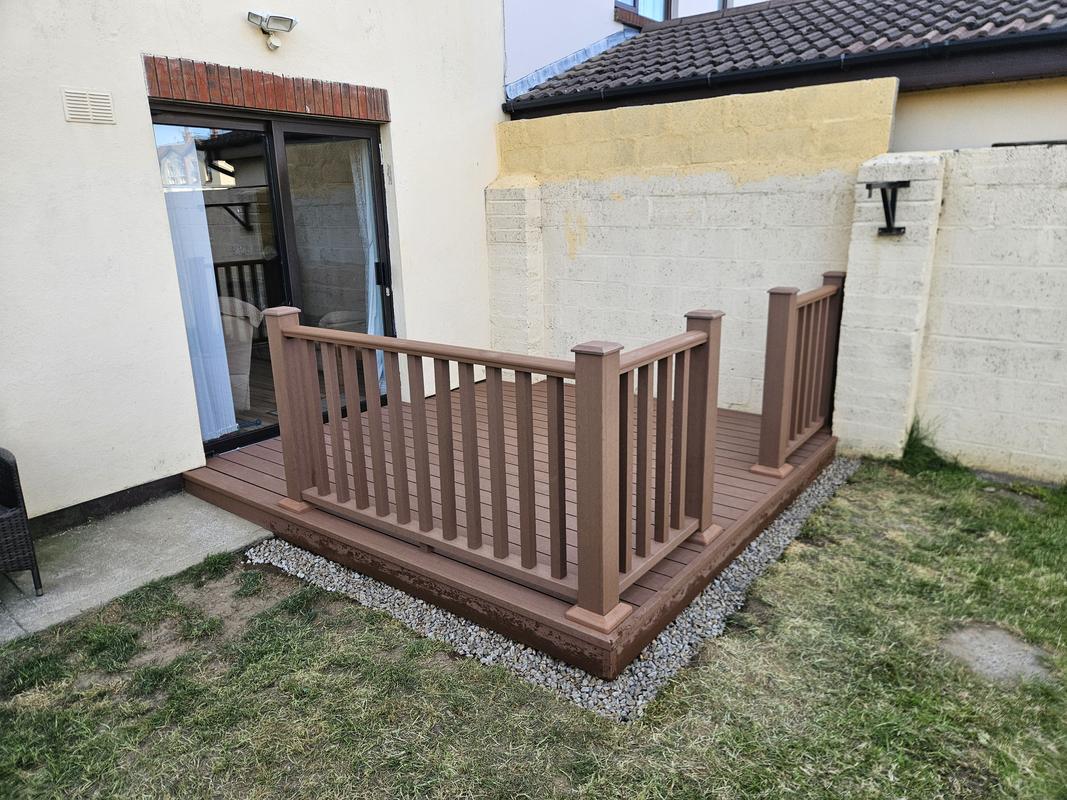
If you have lived through a few Louth winters you already know the worry. The deck looks lovely in June, then November comes, the rain sets in, and you are stepping out the back door wondering if you are about to go over. The east coast is the drier side of the country, but “drier” still means roughly 151 days a year with measurable rain here, against well over 200 in the west, according to Met Éireann’s rainfall data. That is a lot of wet mornings for a deck to stay safe through. The good news is that grip is something you build in, board and frame, not something you cross your fingers about. Here is exactly how we keep a composite deck safe to walk on right through the wet season.
Grooved, Embossed or Gripped: the Surface Is the First Decision
Not all composite is anti-slip, and the surface is where it is won or lost. Broadly you get three finishes, and they do not perform the same in the rain.
- Faint wood-grain emboss. Looks the most like real timber and grips fine when dry, but the shallow texture does little once a film of water is sitting on it. A lot of the early, cheaper composite was effectively smooth, and that is where a fair share of “slippery composite” complaints come from.
- Deep grooved. Channels run the length of the board, breaking up surface water and giving your foot something to bite on. Grooved boards generally outperform a plain wood-grain finish for grip, which is why we favour a defined grooved profile for an exposed Louth garden.
- Moulded grip layer. The top tier of boards, like Millboard’s Lasta-Grip, use a supple, rubber-like surface layer rather than a hard plastic cap. Millboard’s published figures put their grained boards at 36 to 42 PTV wet and the Lasta-Grip range far higher, which is well clear of the safe threshold.
We would rather fit one good grooved or gripped board than two cheap smooth ones. When we quote, we will tell you the wet figure on the actual board going down, not just wave an “anti-slip” sticker at you.
Board Orientation Is Half the Grip
This is the bit most people never hear about, and it is genuinely half the job. The way the board is laid changes how safe it is underfoot.
Grooves should run the way water needs to drain, so the channels carry run-off off the deck instead of letting it pool. Where the layout allows, we set the board so you cross the grooves as you walk rather than skating along a single channel, which gives a firmer footing on the step. Manufacturers and fitters both flag this: laying anti-slip boards with the grain across the main line of foot traffic improves traction.
There is a real trade-off here too. Some boards are reversible, grooved one face and lightly grained the other. Grooves up gives you grip and surface drainage. Grooves down gives a smoother look and a touch more airflow under the board. For a wet Louth garden we will almost always go grooves up, because grip in February beats a marginally smoother summer look. It is a judgement call we make on site, garden by garden.
Drainage and Gaps: Where Wet Decks Are Saved or Lost
A board can be perfectly grippy and still be treacherous if the water has nowhere to go. Standing water is the enemy, so the build is set up to shed it fast.
We build a slight fall into the subframe so the whole surface drains rather than holding a film. We leave the expansion and drainage gaps between boards that the manufacturer specifies, typically a few millimetres, so rain falls straight through to the ground instead of sitting in a puddle. Keeping those gaps clean and clear of debris is what lets water drain away quickly, so we set them right and tell you to keep them clear.
Underneath, the subframe is ventilated and free-draining, set on ground-rated, treated posts and bearers so the timber frame stays dry and sound. A frame that traps damp will rot and sag, and a sagging frame puts dips in the deck where water gathers and ice forms. Get the frame and the falls right and the deck dries itself between showers, which is the whole game in our climate.
Keeping Algae Off Through the Wet Season
Here is the honest part: the green slime that makes decks lethal is almost never the board failing. Algae, moss and lichen grow on the dirt and leaf litter sitting on top, not on the composite itself. A composite board does not rot and does not feed the growth the way old timber does, but in a shaded, north-facing or tree-lined garden, a layer of muck left on the surface will still go green and slippery.
So the maintenance that keeps a Louth deck safe is simple and light:
- Brush off leaves and debris regularly, especially in autumn, so algae has nothing to colonise.
- Wash it with warm soapy water or a deck cleaner a couple of times a year, more often in a shaded spot. A pressure washer on a wide, low setting is fine.
- Keep the gaps clear so water keeps draining through and the surface dries.
That is the lot. No oiling, no sanding, no re-staining. It is low-maintenance, not no-maintenance, and that small bit of upkeep is what keeps the grip the board was built with. If you want the full background on ratings and what makes any deck slip, our piece on whether composite decking is slippery goes deeper on the test values.
We build decks in Dundalk and across County Louth, in Blackrock, Carlingford, Ardee, Castlebellingham and out the Cooley peninsula, plenty of them in shaded or coastal gardens that test a deck through the worst of the winter. If you want one that stays safe to walk on in the wet, with the right grooved board on a frame that drains, call Seamus on 085 168 5170 or message us on WhatsApp and he will call out, look at the garden and get an honest written price back to you.