
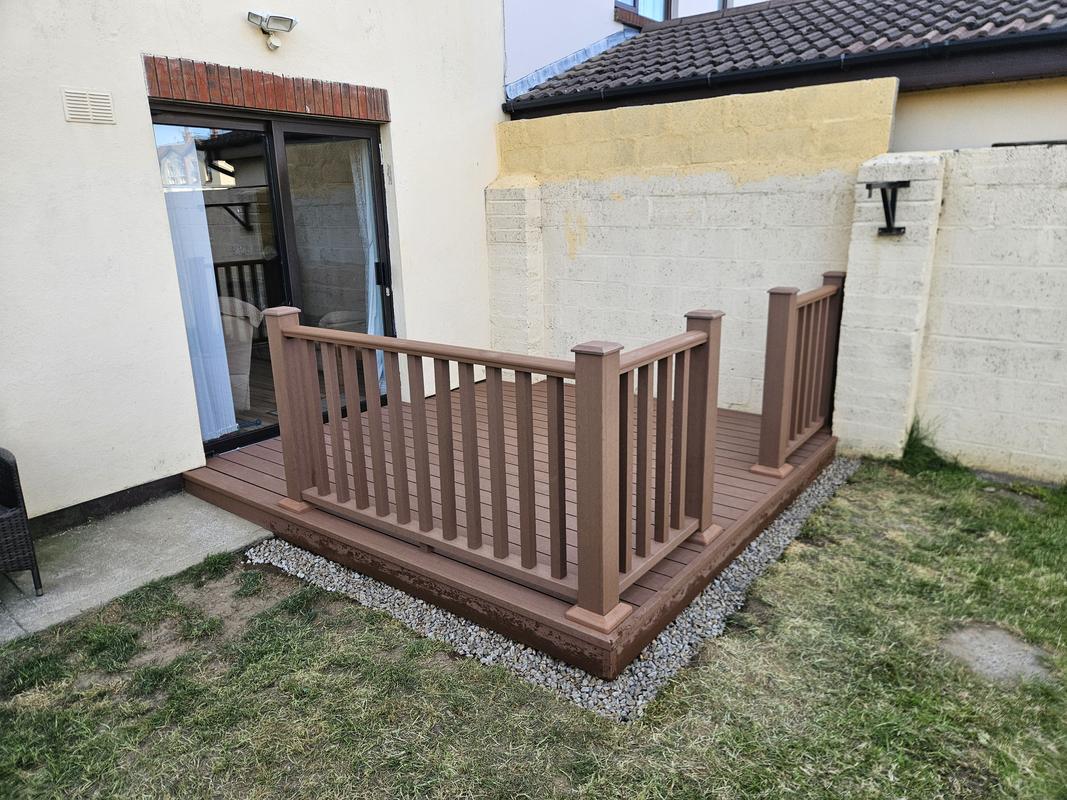
If you have started pricing composite decking, you will have hit the words “capped” and “uncapped” and wondered whether it is just sales talk for charging you more. It is a fair worry. The honest answer is that it is a real difference, not a marketing one, and in a wet County Louth garden it is the single thing most worth understanding before you spend. Here is the plain version of what the cap actually does, what it costs, and which one we would put down in your garden.
What “Capped” and “Uncapped” Actually Mean
Composite decking is a board made from wood fibres and recycled plastic pressed together. The first generation, invented and introduced in the 1990s by Trex, was uncapped: that wood-and-plastic core left bare on every side. It was a big step up from timber, but the exposed core still drinks in some moisture and weathers in the sun.
Capped decking is that same core with a thin, tough polymer shell bonded around it during manufacture, typically a polymer such as high-density polyethylene, polypropylene or PVC. Think of it as a sealed skin over the core. The board you walk on is the cap, not the raw composite, and that one layer is where almost all the performance difference lives.
This is not a niche, premium-only option any more either. The better boards we fit, and the kind we cover in our composite decking work across Louth, are nearly all capped now, because the bare uncapped board has largely been left behind for outdoor use.
Fade, Stain and Moisture: Where the Cap Earns Its Keep
Three things wreck a deck’s looks over time: the colour going, marks soaking in, and water getting into the board. The cap is built to deal with all three.
- Fade. Every composite lightens a little in its first months as it settles, capped or not. After that, the polymer cap resists UV fade, so the colour holds for years. An uncapped board has no such layer, so it greys, patches and dulls far faster.
- Stains. On a capped board the surface is sealed, so spilled wine, a barbecue grease splash or sun cream sits on top and wipes off. On uncapped composite those same spills can soak straight into the exposed fibre and mark it for good.
- Moisture. This is the one that matters most in Louth. The cap holds back water, mould and watermarks where the bare core would draw them in. UK supplier Cladco notes plainly that uncapped decking is “more susceptible to moisture, colour fade and staining” than its capped equivalent.
A quick honest caveat, because it matters and the rule in this trade is to be straight: the cap protects the board, it is not a magic forcefield, and no decking shrugs off a bad build. The core is still doing its job underneath, and good moisture resistance only counts if the frame beneath it drains and stays ventilated. A capped board on a frame with no drainage, sitting in trapped damp, will still struggle. The cap and the build work together, or not at all.
The Price Difference, Honestly
There is a real cost gap, and we will not pretend otherwise. Capped boards cost more than uncapped because of the extra material and the extra manufacturing step. As a rough guide from published UK supplier pricing, capped boards run around ten to fifteen pounds per square metre more than uncapped, which is a similar gap in euro here once you account for board choice and supply.
We do not quote a flat online figure because every garden is different, but the principle is simple: with uncapped you save a bit on the boards and spend it back over the years in scrubbing, prompt stain-cleaning and a deck that ages faster. With capped you pay a little more once and do far less afterwards. If you want to see how the board choice sits inside a full job, our guide to what composite decking costs in Ireland breaks the numbers down properly.
What We Recommend for Exposed Louth Gardens
Here is where the local bit decides it. North Louth gardens, the ones running down towards the water in Blackrock, Carlingford and out across the Cooley peninsula, are wet and exposed. We get plenty of rain and plenty of damp days where surfaces never fully dry, and salt air closer to the coast on top of that.
In that climate the cap stops being a nice-to-have. A bare uncapped core in a shaded, north-facing Carlingford garden that sees little sun and a lot of rain will go green, draw in moisture and start looking tired years before a capped board would. For an exposed or damp Louth garden, we fit capped composite as a matter of course, and we would talk you out of uncapped for that kind of site even though it is cheaper.
The one place uncapped can still make sense is a small, sheltered, sunny deck that gets light use, where the savings matter more than the long-haul performance. Even then we are usually honest that the gap is small over the life of the deck. And whatever board goes down, the build under it has to be right: a ventilated, free-draining subframe, ground-rated posts, and every cut end sealed and trimmed so the bare core is never left open to the wet. That is what makes a capped board actually last, and it is also why the same cap holds its colour for the long run, which feeds straight into how long composite decking lasts in Ireland.
We are a Dundalk father-and-son team fitting composite decking across County Louth, from Ardee and Castlebellingham to Carlingford and the Cooley coast, and we will tell you straight which board suits your garden rather than which one costs the most. Call Seamus on 085 168 5170 or message us on WhatsApp and he will give you an honest steer for your site.