
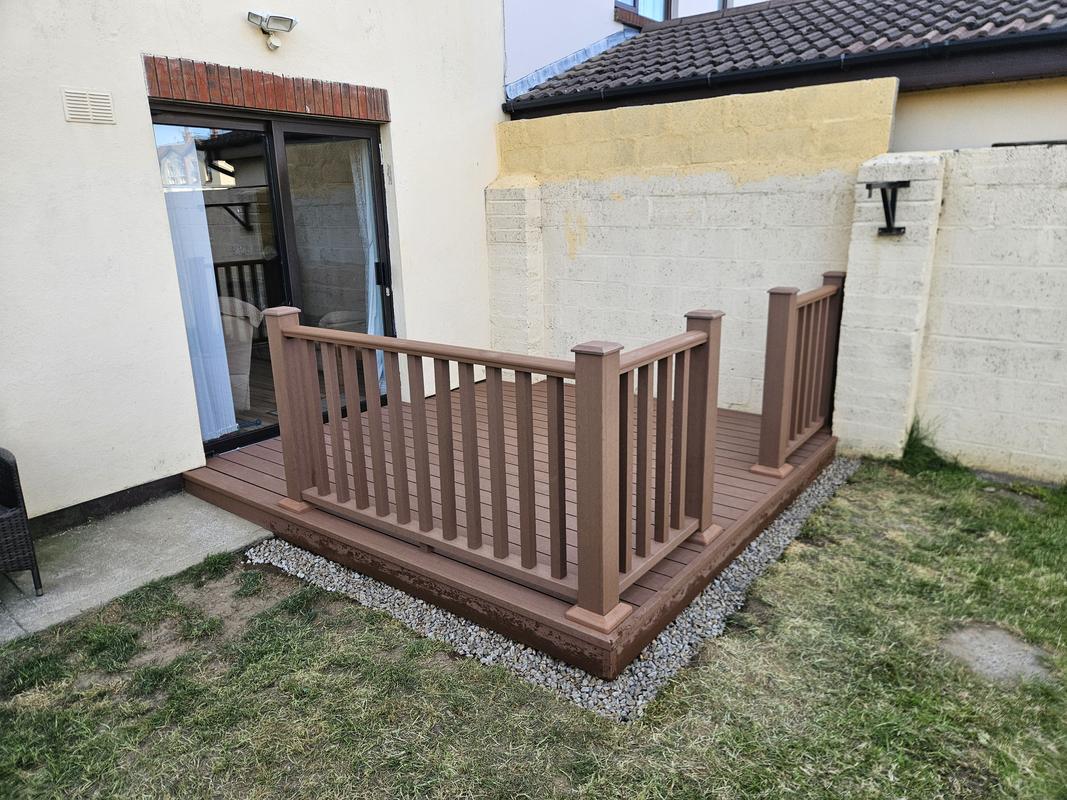
If you are spending real money on a deck, it is a fair question to ask up front: how long is this thing actually going to last me? It is the right question, and composite is usually where people land when they ask it, because they have already been burned once by a timber deck that went grey and tired inside a few years. The honest answer is that good composite decking lasts a long time, often 25 years or more, but the number on the warranty label only tells you half the story. What really decides whether your deck is still solid in twenty years is the build underneath it, and that is the part nobody puts on a brochure. Here is the straight version for an Irish garden.
The Short Answer: 25 Years and Often More
A quality capped composite board, fitted properly, will typically give you 25 years or more of service. That is not a sales figure, it is roughly what the boards are warranted for. Trex, one of the biggest names in the trade, notes that composite boards average about 25 years of service life, with their warranties running from 25 years on the entry boards up to 50 years on the premium lines. Their very first composite product, launched in 1998, is still on plenty of homes and still looking right more than 25 years on.
Compare that to a pressure-treated softwood deck, which typically lasts 10 to 20 years here even when it is kept clean and re-coated, and you can see why composite has taken over. If you want the full timber-versus-composite breakdown, we have written that up in timber versus composite decking for the Irish climate. For the rest of this piece, the short answer stands: think 25 years plus, and that is realistic for a composite deck fitted in Louth, not optimistic.
What the Warranty Actually Covers (and What It Doesn’t)
This is the bit that catches people out, so it is worth being plain about. A quality composite board usually carries two separate warranties. There is a structural warranty against the board itself cracking, splitting or delaminating, and a separate fade-and-stain warranty covering the colour. Trex, for example, backs its boards with a 25-year fade-and-stain warranty alongside the structural one on its residential range.
Here is the catch. That warranty covers the board, and nothing else. It does not cover the frame the board sits on. As the trade guidance puts it plainly, a warranty typically covers the decking but not the substructure underneath it. It also will not cover you if the boards were fitted wrong: ignore the manufacturer’s spacing and fixing rules and you can void the cover entirely.
So a 25-year warranty is a real, genuine reassurance about the surface you walk on. It is not a promise that the whole deck will stand for 25 years no matter how it was built. That distinction is the whole game.
The Frame Decides the Lifespan, Not the Board
This is the thing we say to nearly everyone who calls us about composite. The board is the easy part. The frame under it is what decides whether your deck is sound in fifteen years.
Think about it. You can lay a 50-year board on a frame of cheap, poorly-treated timber sitting flat on wet ground with no air to it, and the boards will be perfect while the frame rots out from under them. The trade is blunt about this: the frame’s strength matters more than the strength of the boards themselves, and a fine deck on a weak frame is destined to fail. A standard timber subframe might only give 10 to 15 years if it is not built right, while the boards on top are warranted for double that.
That gap is where badly built decks die. The fix is not complicated, it is just done properly:
- Ground-rated, pressure-treated timber for the frame, the grade made to handle being wet for long spells (Use Class 4 for anything near the ground).
- A ventilated, free-draining frame lifted clear of the soil, so air moves underneath and water never sits against the timber.
- The right fixings. Composite boards expand and move with the heat, and corroded or wrong fasteners are a classic cause of an unstable deck. Quality stainless or coated fixings and hidden clips, fitted with the gaps the manufacturer asks for.
- A slight fall on the surface so rain runs off along the boards instead of pooling.
Get those right and the frame keeps pace with the boards. Get them wrong and the warranty on the board is no comfort at all, because it was never the board that failed.
Does It Hold Up in a Damp Louth Climate?
This is the real question for anyone here, and it is a fair worry given how wet our winters are and how exposed the coast gets from Blackrock round to Carlingford and out the Cooley peninsula. Salt air, near-constant damp, shaded gardens that never properly dry out: it is a hard test for any deck.
This is exactly where composite earns its keep. A capped composite board has a hard outer shell wrapped around the core, and that cap is what shrugs off the moisture, the UV and the algae that turn a timber deck green and slippery. It does not need the annual oiling or sealing that timber demands to stay sound, and it resists the wet far better than untreated wood. In practice that means a couple of washes a year with a brush and a hose, rather than a lost weekend every spring.
A word on fade, since it comes up. Composite does shift colour a little, but mostly in the first few months, settling to a slightly lighter, even tone and then holding. Fade warranties are written to allow for that small initial change and to cover anything beyond it. And honestly, in our cloudy climate, heavy sun-fade is far less of an issue than it is in hotter countries. If grip in the wet is your main worry, that is a fair one too, and we have covered it properly in capped versus uncapped composite decking, because the cap is what does most of the work there as well.
So: how long does composite decking last in a damp Irish coastal garden? A long time, if it is built right. The boards are made for exactly this weather. The frame underneath has to be too.
We are a Dundalk father-and-son team fitting composite decks across County Louth, from Ardee and Castlebellingham out to the coast at Carlingford, and we build the frame to outlast the warranty on the boards, not just to pass the day we leave. Call Seamus on 085 168 5170 or message us on WhatsApp and he will tell you honestly what to expect from your garden and which boards we would stand over.