
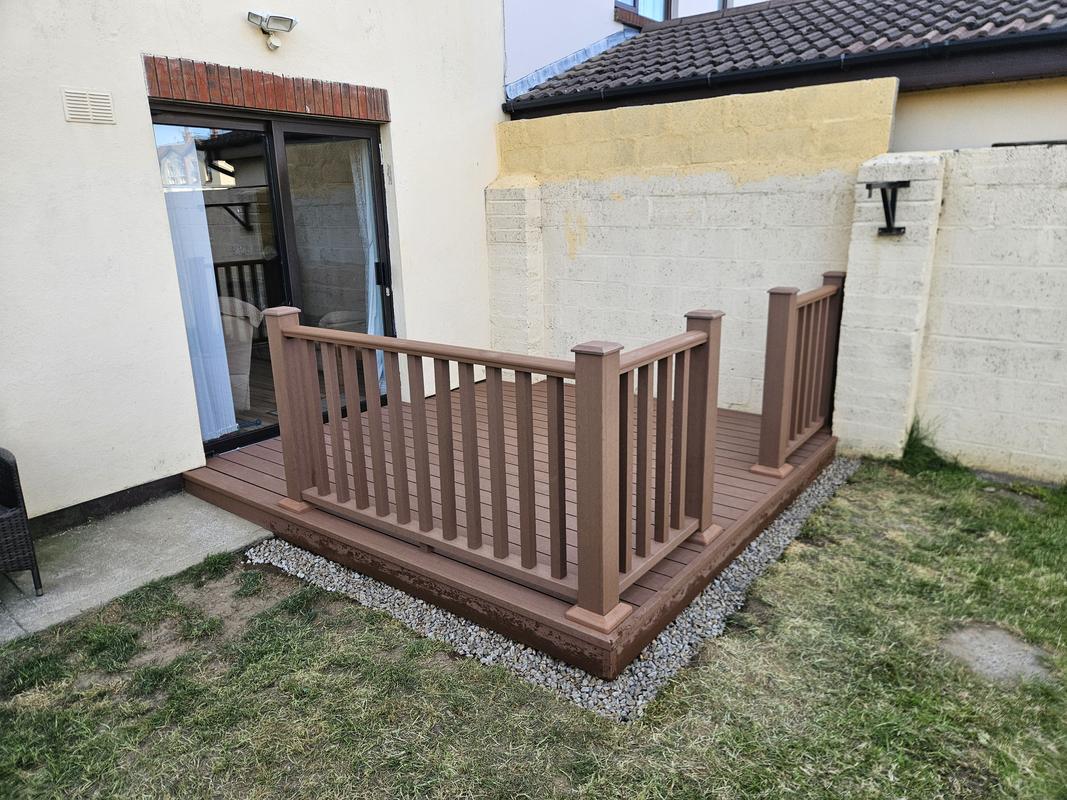
It is the question nearly everyone asks before they commit, and a fair one when you are spending a few thousand on something meant to last twenty years. Timber vs composite decking is rarely a clean win for either side in Ireland. We fit both across County Louth, and the right answer depends on your garden, your budget and how much upkeep you are honestly willing to do. Here is the straight comparison, built around the things that actually go wrong with decks here: rot, slip, lifespan and cost. No favouritism, just what we would tell you standing in your back garden.
The Honest Short Answer on Timber vs Composite
Neither wins outright. Timber costs less to buy, feels warm underfoot and looks natural, but it asks for upkeep and will fail early if it is built or maintained badly. Composite costs more to buy, needs almost no maintenance, shrugs off the wet and grips better when it is on the ground, but you pay for that upfront and it never quite has the feel of real wood.
If your garden is sunny and you genuinely enjoy giving a deck a clean and a coat of oil now and then, timber is a sound, good-value choice. If your garden is shaded or damp, or the thought of annual maintenance fills you with dread, composite usually earns its higher price back. Most of the regret stories you have heard come not from picking the wrong material, but from a deck built wrong in the first place. Build either one properly and both can work here.
Rot and Warping: How Each Holds Up in the Damp
This is where the Irish climate does its damage. Timber rots when water sits on it and soaks into bare cut ends, and it warps when it is fixed without room to move. None of that is inevitable. A timber deck built on a ventilated, draining subframe with sealed ends and the right treated or hardwood boards will hold up for years. A timber deck thrown together with untreated boards and trapped damp will go grey and soft in two or three winters. The wood does not decide that, the build does.
Composite sidesteps the question. It is a wood-and-plastic board, and the capped boards have a hard outer shell that does not absorb water, so it stands up to the wet far better than poorly built timber does. That is the single biggest reason people switch to low-maintenance composite decking the second time around, especially after a bad experience with a timber deck that did not last.
Slip and Safety in the Wet
A wet deck is a hazard, and Ireland gives you plenty of wet. Old, smooth or algae-covered timber is where most of the “lethal when it rains” stories come from. A modern composite board with a textured, grooved surface grips noticeably better in the wet, and resists the green algae that makes any deck slippery. In Ireland and the UK a surface with a wet Pendulum Test Value of 36 or above is rated low-slip, and good composite boards clear that comfortably.
Timber can be made safe too, with a grooved board, decent drainage and a yearly clean to keep algae off, but it takes more discipline. If safety underfoot is your top priority, particularly with young children or older relatives using the garden, composite has the edge straight out of the box.
Lifespan and Maintenance
Here is the trade-off in one line: timber is cheaper to buy and dearer to keep, composite is dearer to buy and almost free to keep.
A well-built treated softwood deck lasts around fifteen years, sometimes more with good upkeep, and quality hardwood longer again. The catch is the upkeep: a clean and a fresh coat of oil or stain every year or two to stop it greying and cracking. Skip that and the lifespan drops fast. Composite, by contrast, typically lasts twenty-five years or more, and most quality capped boards carry a 25-year warranty to match. The whole maintenance job is a wash with warm soapy water a couple of times a year. No oiling, no sanding, no re-staining, ever.
Upfront Cost vs Cost Over Time
Timber wins on day one and often loses over twenty years. Treated softwood is the cheaper material per square metre, which is why a lot of people start there. But the honest sum is the total cost of ownership: the boards, the fitting, and then years of oil, stain and the odd replaced board. Add it all up and a composite deck that looked dear at the quote stage frequently works out the better value across its life, because the maintenance line is close to zero.
The gap is real money, not a rounding error, so it is worth pricing both properly before you decide. Our guide to what composite decking costs in Ireland sets out the per-square-metre figures and a worked example for a typical back garden, so you can weigh the upfront difference against the years afterwards.
Built for Wet Louth Weather, Not the Med
A lot of the decking advice online is written for hot, dry climates where timber bakes and lasts and composite gets too warm underfoot. That is not the weather we build in. Around Dundalk and across County Louth, gardens are damp, often shaded, and close to the coast in spots like Blackrock and Carlingford, exactly the conditions that punish a badly chosen or badly built deck.
That local reality shapes what we recommend. For a north or east-facing garden that stays wet and dries out slowly, we will usually steer you toward composite for the moisture resistance and grip. For a sunny garden where you want the natural look and you will keep on top of the upkeep, properly built hardwood and softwood decking is still a great choice. The point is to match the deck to your garden and your habits, not to sell you the dearer option.
We fit both timber and composite right across County Louth, and we will give you a straight recommendation for your garden rather than a sales pitch for the dearer board. Built right, priced straight, left tidy, whichever you choose. Get a free, no-surprises quote, call Seamus on 085 168 5170, or message us on WhatsApp, and he will call out, look at the garden, and talk you through both.