
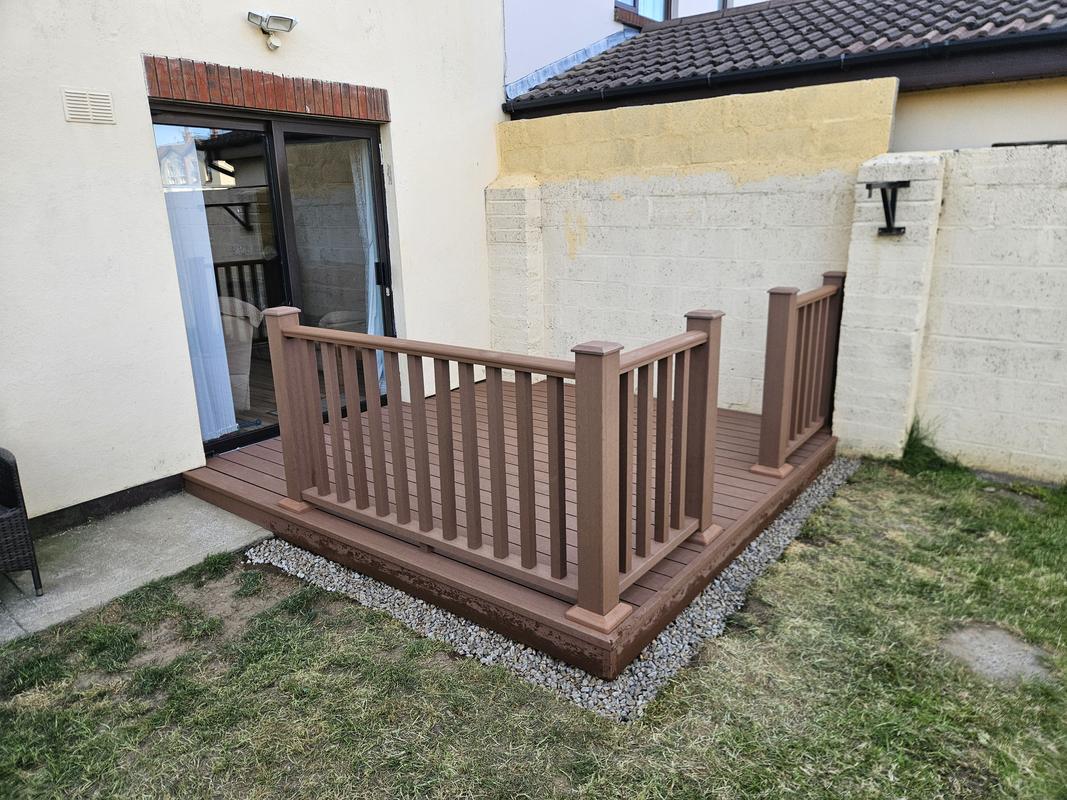
It is the first thing a lot of people in Louth ask, and fair enough. Anyone who has had an old timber deck knows the feeling of stepping out after rain and nearly going over. Plenty of people have ended up searching whether composite decking is slippery before they spend a penny, because they have heard the horror stories: boards that turn lethal the minute it rains, the kind where you and the other half have both slipped more than once. Here is the honest answer, with no sales gloss. A good composite board grips well in the wet. A poor one, or a good one left to go green, will not. The difference is the board you pick, how it is built, and whether it is kept clean.
The Honest Answer: It Depends on the Board, the Build and the Cleaning
Composite decking is not slip-proof. Nothing is. Around 90% of slips happen on wet surfaces, and a deck in a Louth garden is wet for a good chunk of the year. What composite does is start with a real advantage: a modern, textured, grooved board grips far better in the wet than smooth, untreated timber, which is where most of the slipping stories actually come from.
The catch is that “composite” covers everything from a cheap, smooth board that gets greasy in the rain to a properly textured, anti-slip board engineered for exactly this climate. The early generation of composite was often smooth and looked grand when dry, but the grip dropped away the moment it got wet. The boards worth fitting today have micro-grooves and a wood-grain texture pressed into the surface, and those tiny ridges are what keep your foot planted when it is lashing.
So when we fit a deck, the board choice is half the job and the build is the other half. We fit the anti-slip composite boards we would stand over, laid on a frame with a slight fall built in so water runs off instead of sitting in a film on top. Get those two things right and the slip problem is largely solved before you ever walk on it.
What Actually Makes a Deck Slippery
It is rarely the board on its own. The real culprit on nearly every slippery deck in Ireland is the green stuff: algae, moss and lichen. These grow in damp, shaded spots, and they leave a slimy biofilm that is genuinely treacherous underfoot. Composite resists rot and holds up far better than timber, but algae can still take hold on a layer of dirt, leaves or pollen left sitting on the surface. That is why a north-facing or tree-shaded back garden goes slippery faster than a sunny one, and why a deck that is never brushed will catch you out no matter what it is made of. If your existing deck has already gone that way, our guide on why a deck turns green and slippery walks through the fix.
Three other things turn a deck slippery, and all of them are manageable:
- Standing water. A flat deck with no fall lets a film of water build up. A slight slope for run-off, built into the frame, sheds it.
- Ice and frost. A cold snap will make any outdoor surface slick, composite included. Nothing fixes physics here, but a grooved board with good drainage is far safer than a smooth, wet one once the frost lifts.
- A worn or smooth surface. A cheap board with no real texture, or an old one whose texture has worn down, will not grip. This is a board-choice problem, not a composite problem.
The honest takeaway: composite gives you a head start on grip, but it does not excuse you from a brush and a wash a couple of times a year. The good news is that is the whole maintenance job, no oiling, no sanding, no re-staining.
How to Tell if a Composite Board is Genuinely Anti-Slip
This is where you can cut through the marketing. In Ireland and the UK, slip resistance is measured by the Pendulum Test (BS 7976), which gives a board a Pendulum Test Value, or PTV. A PTV of 36 or above, tested wet, is the threshold for “low slip risk” and is what lets a surface be certified anti-slip. For an exposed outdoor deck collecting rain all winter, an R11 rating (roughly PTV 31 to 41) is the sensible target.
Two things the brochures will not tell you. First, the scale is not linear. A board that drops from a PTV of 36 to 34 is not a touch worse, it is around ten times more likely to let you slip. Second, plenty of composite boards only just scrape over 36 when brand new, and that grip can fade over years of foot traffic. So a board that “passes” on paper is not the same as a board that stays safe a decade in.
That is the bit that matters when you are choosing. Ask for the wet PTV figure, not just a vague “anti-slip” claim, and favour a board with a deep, defined grooved profile rather than a faint texture. When we quote, we will tell you which boards we would put in our own garden and why, rather than chasing the cheapest one that clears the line.
Built for a Wet Louth Winter
We build decks in Dundalk and right across County Louth, and a fair share of those gardens are shaded, sheltered or close to the coast in spots like Blackrock and Carlingford, exactly the conditions that turn a poorly chosen deck green and slippery. So we build for it from the frame up. The board goes down grooved-side up and oriented for run-off, the subframe is set with a slight fall so water drains away, and we leave the edges and gaps clear so the deck dries between showers instead of trapping damp.
That local knowledge is the difference between a deck that looks good in a brochure and one that is safe to walk on through a wet Louth February. If you want the full detail on the boards and the build we use for the worst of the weather, see our piece on anti-slip composite decking for Louth’s wet winters.
If you want a deck that stays safe to walk on through an Irish winter, that is exactly what we build, with the right anti-slip board on a frame that drains, finished neat and quoted honestly. No slippery boards, no hidden costs. Get a free, no-surprises quote, call Seamus on 085 168 5170, or message us on WhatsApp. He will call out, look at the garden, and get a written price back to you.