
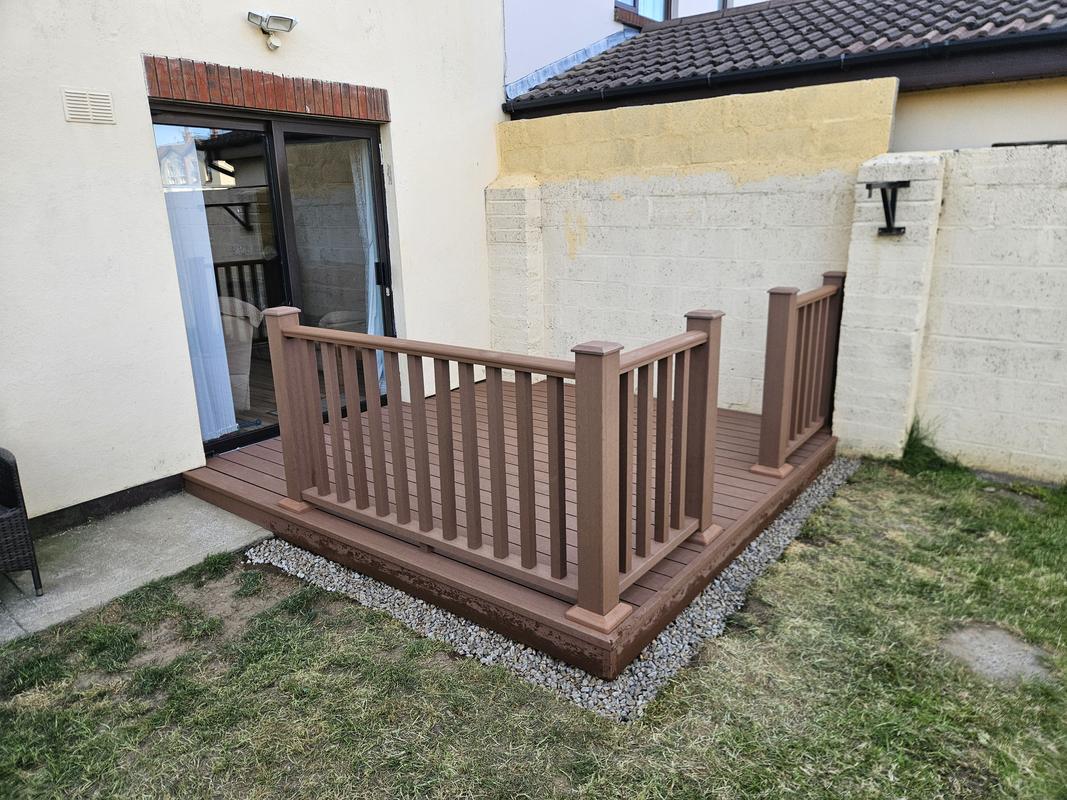
A lot of the back gardens we deck around Dundalk are on the small side: terraces, semi-ds and new-builds with a compact, often narrow patch out the back. The good news is that a small garden is exactly where a well-designed deck earns its money, because it turns an awkward, underused square of grass or muck into a proper outdoor room. Here are the composite decking ideas that genuinely work in a small garden, from board direction to built-in seating and lighting, all learned from real jobs in local gardens rather than a glossy catalogue.
Use Board Direction to Make the Space Feel Bigger
The way the boards run changes how a small garden feels, and it costs nothing to get right. Run the boards lengthways, away from the house, and the eye follows them down the garden, making a short space feel longer. In a narrow garden, running them across the width does the opposite and makes it feel wider. A diagonal layout adds a bit of interest and can disguise an awkward shape, though it uses a little more board.
A neat trick for a small deck is a picture-frame border: a perimeter board, sometimes in a contrasting colour, that frames the deck and hides the cut ends of the main boards. It makes a modest deck look properly finished rather than just laid.
Build the Seating In
In a small garden, bulky garden furniture eats the floor you are trying to create. Built-in bench seating around one or two edges of the deck solves that. It hugs the perimeter, leaves the middle clear, and seats more people than a table and chairs would in the same footprint. Better still, the space under the benches can be built as storage for cushions and bits.
Because composite does not need sealing or oiling, built-in seating and integrated planters made from the same board age at the same rate as the deck and stay looking right. Planters along an edge soften the look and bring in greenery without taking up usable floor.
Light It for the Evenings
Lighting is what makes a small deck usable after dark and, oddly, what makes it feel bigger at night. Recessed lights set into the deck surface, lights in the risers of any steps, and a few along the perimeter all add depth and draw the eye outward, so the garden does not just disappear into a black wall once the sun goes.
Low-voltage deck lighting is straightforward to build in as we go. If you want mains-powered lighting or sockets out there, that should be wired by a registered electrician, which we can factor into the plan from the start rather than retrofitting later.
Make a Sloped or Awkward Small Garden Work
Plenty of small town gardens are not flat. A slope, a step down, or a bank that has never been used is common, and it is where a raised or split-level deck comes into its own. Levelling the usable area up onto a deck reclaims ground you could not stand on before, and a low split level can zone a tiny garden into a dining bit and a sitting bit without a wall. For the detail on building over uneven ground, see our decking for awkward or uneven gardens.
Colour, Privacy and Keeping It Uncluttered
Two last things that make or break a small deck. First, colour: a lighter board reflects more light and helps a small or shaded garden feel brighter and more open, while a dark board feels cosier but can close the space in, so choose with your aspect in mind. Second, privacy: a lot of town gardens are overlooked, and a slatted composite screen or a higher balustrade along one side gives you somewhere to sit without an audience, and it matches the deck rather than looking bolted on.
Above all, keep it simple. In a small space, one clean layout beats a fussy one every time.
Designed for Dundalk Gardens
Most of these ideas come straight from decking compact gardens across Dundalk and County Louth, where the challenge is nearly always making a little space do a lot. We design the deck to your garden, the size, the aspect, where the sun sits in the evening, rather than fitting a standard shape and hoping. If you are picturing a composite deck for your garden, that is exactly the conversation we will have when we call out.
Two practical notes. Decking is generally exempt from planning permission, but a deck that covers most of a small garden or raises the ground by more than a metre can run into the rules, so it is worth a quick check with Louth County Council on a larger build. And if budget is the question, our guide to what a small composite deck costs sets out the figures so you can plan around them.
If you have a small or awkward garden in Dundalk or anywhere across Louth and you want to make the most of it, we will design a deck around the space rather than around a template. Built right, priced straight, left tidy. Get a free, no-surprises quote, call Seamus on 085 168 5170, or message us on WhatsApp.