
There are not many places in Louth with a back garden like Carlingford. The village sits on the shore of the lough at the foot of Slieve Foye, with the Mourne Mountains rising across the water, and the gardens fall away down the slope toward all of it. The trouble is that a steep garden is hard to use, and a single flat deck wastes both the slope and one of the best views in the county. Multi-level decking solves both at once. Here are some multi-level decking ideas that work particularly well on the sloped, scenic gardens around Carlingford and the Cooley peninsula.
Work With the Slope, Not Against It
The instinct with a sloping garden is to flatten it. On a Carlingford hillside that means retaining walls, heavy digging and a lot of expense, and you still end up with one flat patch. A far better approach is to terrace the fall into two or three connected decks at different heights, each one a flat, usable area in its own right.
That is the whole idea behind raised and multi-level decking. Instead of one platform fighting the gradient, you get a series of levels that step down the garden, linked by steps, each with its own purpose. The slope stops being a problem to overcome and becomes the thing that gives the garden its shape.
Build the Deck Around the View
This is where a Carlingford garden is different from one in the middle of Dundalk. You are not just making a flat space, you are framing a view across the lough to the Mournes, with Slieve Foye behind you.
So the first design decision is orientation. Set the main living tier to face out over the lough, and keep whatever sits between you and the water low and open. A glass or thin wire balustrade on the highest level keeps the deck safe without putting a row of timber bars across the very thing you built it to look at. A lower tier that projects a little further down the slope can feel like a lookout over the water, which is hard to beat on a bright evening.
Multi-Level Ideas for a Carlingford Garden
A few ideas that suit a sloped, exposed garden here:
- Zone by level. Put the dining deck on the upper tier nearest the kitchen, where carrying plates out is easy, and a lower tier for lounging, a fire pit or a hot tub, a step or two down. Separating the busy zone from the relaxing one is what makes a garden feel bigger than it is.
- Make the steps part of the deck. Wide, generous steps between levels double as casual seating when you have people over, and broad treads feel far safer than a narrow flight on a slope. They become a feature rather than just a way down.
- Carve out a sheltered nook. The lough can throw a stiff breeze up the hill, so a corner with built-in seating, some screening or planting at its back gives you somewhere usable when the wind is up. The detail of how a multi-level deck is built on a slope matters here, because a sheltered lower level needs the structure to suit it.
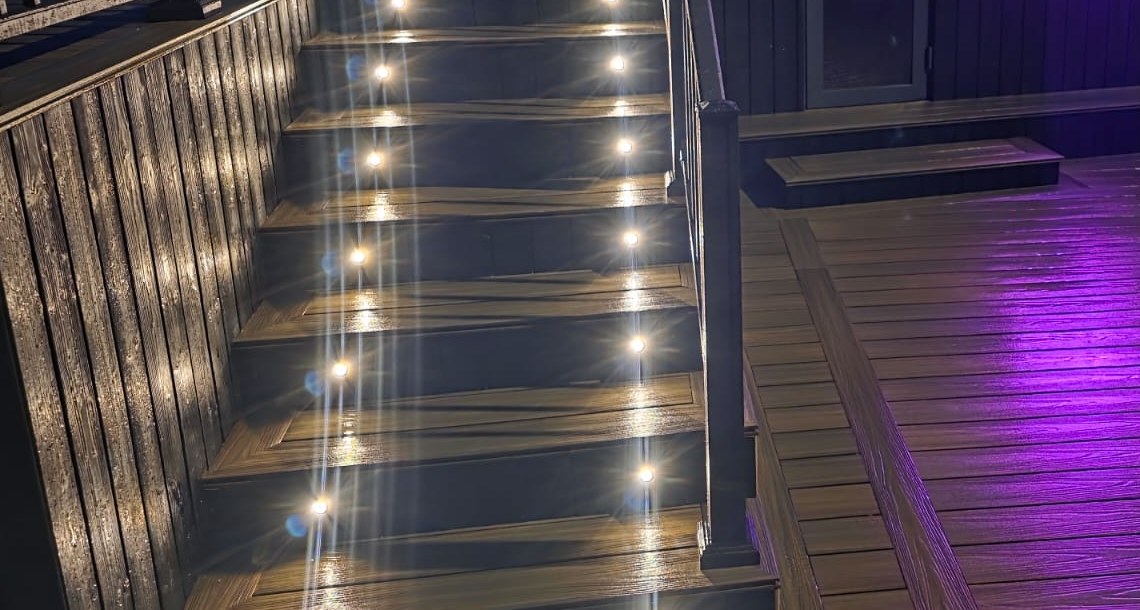
- Light the levels for the evening. Recessed lighting in the step risers and along the edges makes the deck safe to move around after dark and lets you sit out long after sunset, which is when that view is at its best.
- Frame zones with planters, not just railings. Built-in planters and low seating define one level from the next and soften the timber, without walling off the outlook.
- Plan for a hot tub early. A hot tub is a popular ask on a Cooley garden, but it is heavy, so the level that carries it needs extra structural support designed in from the start, not added later.
Materials, Wind and Planning
An exposed coastal garden is hard on a deck. Salt in the air, driving rain off the lough and constant damp all shorten the life of a poorly chosen board. For a site like this, low-upkeep composite with an anti-slip surface usually makes more sense than timber that needs constant upkeep in the wet, and good-quality fixings that will not corrode are worth every cent.
One thing worth checking early: because a multi-level deck can sit higher off the ground than a simple platform, it is more likely to need planning permission. Decking is generally treated as a garden alteration and is usually exempt once it sits no more than one metre above ground level, but anything taller, or that overlooks a neighbour, is worth confirming with Louth County Council. Citizens Information sets out the exempted development rules for altering a house and garden, and we will tell you where your design falls. The height and the steps are also a big part of what a multi-level deck costs, so it is worth thinking about both at the design stage.
If you have a sloping garden around Carlingford or anywhere on the Cooley peninsula and you can picture it as a proper outdoor space, it is well worth getting someone out to look at the fall and the view before you settle on a design.
Call Seamus on 085 168 5170 for a free quote, or message us on WhatsApp.