
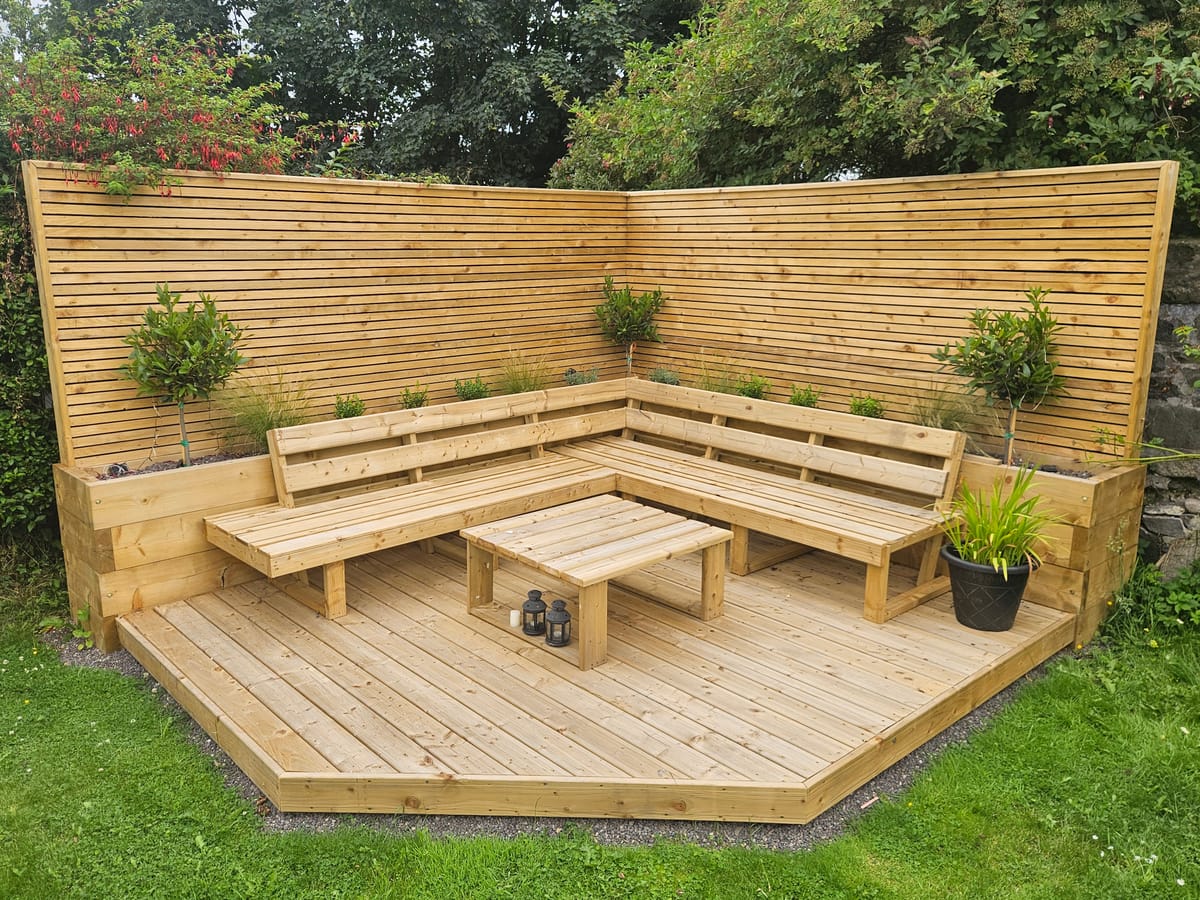
If your deck has turned a dull silver-grey and gone slick with green every winter, you are not alone, and you have not been sold a dud. Going grey and going green are the two most common complaints we hear about timber, and the honest news is that both are normal, both are caused by our weather, and both are fixable with a routine that takes an afternoon a year. Here is the straight version of why it happens and exactly what to do about it, written for a damp Louth garden rather than a sunny patio in Spain.
Call Seamus on 085 168 5170 for a free quote or message us on WhatsApp.
Grey and Green Are Two Different Problems
People lump them together, but they are separate things with separate fixes, so it helps to know which you are looking at.
Grey is the sun. Timber turns silver-grey through UV greying. The ultraviolet in daylight breaks down the lignin in the wood, the natural glue that holds the colour, and the surface fades. As one UK wood-finish supplier explains, lignin acts as a photo-sensitiser that absorbs UV and degrades the cellulose, which is why any bare timber left in the open eventually goes grey. It is purely cosmetic at first, but it is the early warning that the protective coat has worn off.
Green is the damp. The green film, the fuzzy patches and the black-green staining are algae, moss and mould. They thrive, in the words of one timber merchant, in damp, shaded conditions, and a shaded back garden in Louth gives them exactly that. The green is not just ugly. It holds moisture against the boards and makes the deck slippery, which is a real hazard on a wet morning.
If your timber is sound but tired-looking, this is a clean-and-coat job, not a rebuild. None of this means timber is a bad choice. A well-built timber deck handles our weather fine, it just asks for a wash and a coat each year in return. If the boards feel soft or spongy underfoot, that is a different story, and our decking repairs come into play. If the slippery green is the part that worries you most, we go deeper on grip in our guide to a green, slippery deck.
Why a Louth Garden Is Harder on Timber
It is not your imagination that decks go off quicker here than in the brochures. We get a lot of wet. Met Éireann puts the east coast at around 151 wet days a year, and the further into the hills or the shade you go the damper it gets. That is a lot of days where water is landing on your boards and looking for somewhere to sit.
Three things decide whether that water becomes a problem. Does it drain off, or pool? Does air get under and around the deck to dry it, or is it boxed in? And does any light reach the surface to keep the algae down? A deck in full shade behind a north-facing wall in Blackrock or Carlingford, with leaves dropping on it and water pooling in the grooves, is going to go green no matter how often you scrub it. The maintenance starts with the conditions, not the brush.
The Yearly Routine That Actually Keeps It Right
Here is the routine we give every timber customer. Do this and your deck stays looking well for years longer than one that is left to fend for itself. Pick a dry-ish spell, ideally late spring, so the timber can dry out fully before you coat it.
- Clear and sweep. Take everything off the deck. Sweep off leaves, moss and grit, and dig the muck out from between the boards and out of the grooves. This is where damp sits, so do not skip it.
- Wash it. Scrub with warm water and a squirt of washing-up liquid, or a dedicated deck cleaner, working along the grain with a stiff brush. For stubborn algae, a weak white vinegar solution, roughly one part vinegar to twenty parts warm water, lifts the green. If you reach for a pressure washer, keep it on a low setting and keep it moving, because high pressure furs up and damages the timber.
- Let it dry fully. Give it a couple of dry days. Oiling over damp timber is the classic mistake and the coat will not take. The boards need to be properly dry, not just touch-dry after an hour.
- Re-coat with a pigmented decking oil. A decking oil with a bit of colour and built-in UV filters does two jobs at once: it sheds water, which holds off the green, and it slows the greying, because the pigment shields the timber from the sun. Two thin coats beat one thick one. This is the step that protects the deck for the year ahead.
- Keep on top of it through the year. A quick sweep every few weeks, clearing pooled water and fallen leaves, and a cut-back of any overhanging shrubs to let light and air in, keeps the green from ever getting a grip. Letting sunlight reach the wood and clearing debris is half the battle.
How often you re-coat depends on the spot. A fully exposed deck in the sun may want a fresh coat every year. A sheltered one might stretch to two. A board sitting in permanent shade is the high-maintenance one, and that is worth knowing before you build there.
When the Real Fix Is the Build
A clean and a coat sorts the cosmetic side. But if a deck goes green again within weeks every single time, the timber itself is staying wet, and no amount of oil fixes a drainage problem.
This is where a good build earns its money. A deck laid with a slight fall, so rainwater runs off the grooves instead of pooling, a subframe with an air gap so the underside dries between showers, and cut ends sealed so damp can not soak in where you can not see it, gives the algae far less to work with. That is how timber rots and goes green in the first place: water that has nowhere to go. Get the airflow and the run-off right and the yearly routine above is genuinely all it takes. Get them wrong and you are mopping up forever.
If your current deck was built flat, boxed in tight to the ground with no ventilation, that is the honest reason it keeps going green, and it is worth a proper look before you spend another season scrubbing it. Where boards have already gone soft, our decking repairs page sets out what can be saved and what needs lifting.
We are a Dundalk father-and-son team building and restoring timber decks across County Louth, in Blackrock, Carlingford, Ardee and the Cooley peninsula, and we have cleaned up enough green, grey decks to know which ones just need a wash and which ones need the drainage sorted. Call Seamus on 085 168 5170 or message us on WhatsApp and he will tell you straight whether yours is a routine or a rebuild.