
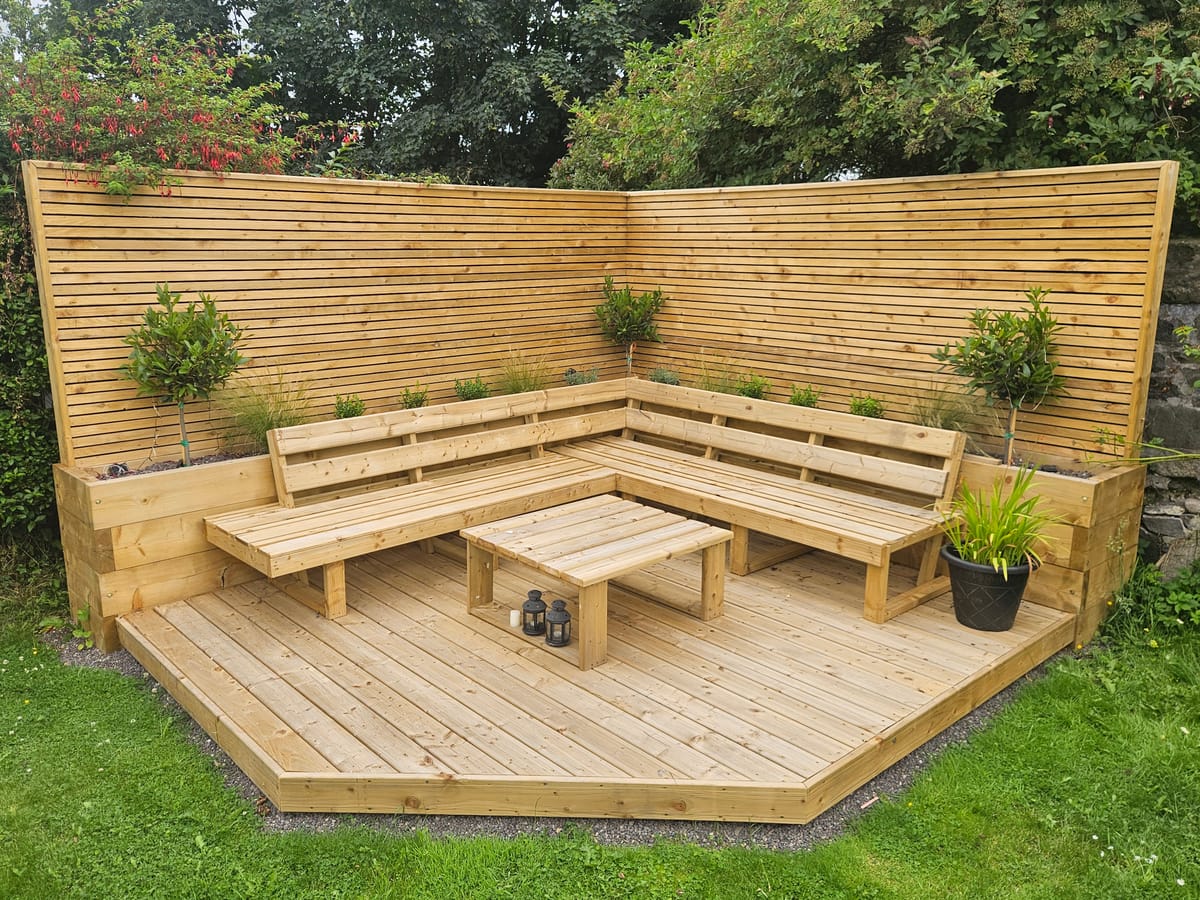
If your garden looks out over Carlingford Lough or sits up on the Cooley Peninsula with the wind coming straight off the water, you already know it is a harder place to keep anything looking well. Paint peels faster, gates rust, plants get scorched by salt. So the fair question before you spend money is whether a timber deck will last out there at all, or just go grey and soft within a few winters. The honest answer is that timber works fine on the coast, but only if it is built for the coast. The salt air, the wind and the driving rain are real, and they punish a cheap build fast. Here is what actually goes wrong near the sea and how we build around it.
This is the exposed-coast version of our general timber decking guidance. If your garden is sheltered and inland, that page covers you. If you are in Blackrock, Carlingford, Greenore or out the Cooley Peninsula, read on, because the details change.
What Salt Air and Wind Actually Do to a Deck
People assume the timber rots first. Usually it does not. Near the coast the first thing to go is almost always the fixings. Sea air carries fine salt that settles on every surface, and salt holds moisture against metal and eats it. Ordinary galvanised screws, and even some cheap coated ones, start to corrode, the heads rust, and they bleed rusty streaks down the boards before they eventually lose their grip. There is a second problem on top of that: the copper-based preservatives in modern treated timber can react with galvanised fixings and speed up the corrosion, an issue the fastener trade flags specifically for coastal and treated-timber jobs.
Salt does work on the wood too, just more slowly. It draws moisture in and out of the grain and can push the surface fibres apart, which is why a neglected coastal deck greys and gets that fuzzy, lifted look quicker than an inland one. And then there is the wind. The prevailing weather here comes off the Atlantic from the south-west, but on an exposed east-coast lough you also catch hard easterlies straight off the sea, and Met Éireann’s wind records show how much stronger and saltier the air is right on the coast. Wind drives rain into every joint and end-grain it can find, and on a raised deck it can also try to lift boards that are not fixed down properly.
None of that means timber is the wrong call. It means the build has to answer each of those problems.
The Fixings: Marine-Grade Stainless, Not Galvanised
This is the single biggest thing we change for a coastal job, and it is the one corners get cut on. We fix coastal decks with A4 or 316 marine-grade stainless steel screws throughout. The 316 grade has a small amount of molybdenum in it, and that is what resists the chloride in salt air that pits and rusts lesser metals. The trade guidance is blunt about it: for anything within reach of the shoreline, 316 marine-grade stainless is treated as required, not optional.
Stainless costs more per box than galvanised. On a coastal deck it is the cheapest insurance you will buy, because re-screwing a whole deck in a few years when the galvanised heads have rusted out costs far more than the screws ever saved. The good news is that stainless is also immune to the preservative chemistry in treated timber, so the two work together rather than against each other.
The Timber and the Frame: Treated Right, Built to Drain
The boards you see are only half the deck. The frame underneath decides how long it lasts, and near the ground in a damp coastal garden that matters even more.
- Subframe in ground-rated timber. Joists, beams and posts sit near or on the ground, where they stay damp longest, so they need Use Class 4 timber, the grade rated for ground contact. The deck boards themselves can be Use Class 3, the above-ground exterior grade. The timber-use-class guidance puts deck boards in Class 3 and the sub-structure (joists, beams and posts) in Class 4 for exactly this reason. Getting this right is quiet, invisible work, and it is where bad decks fail.
- Sealed cut ends. Every time a treated board is cut, the fresh end is raw and unprotected, and end-grain drinks water. We re-treat every cut end before it goes down, so the damp cannot get in where you will never see it. On the coast this is not optional.
- A frame that breathes and drains. We build a ventilated subframe with an air gap underneath and lay the surface with a slight fall so rain runs off along the grooves instead of sitting. Standing water and trapped damp are what start rot. Moving water off the deck and air under it is most of the battle.
- Fixed down for the wind. On a raised or exposed deck we fix the boards and the frame down properly, and tie the structure back to solid ground-rated posts, so a hard easterly gust off the lough cannot lift, creak or rattle it. A deck that moves in the wind works its fixings loose over time, and loose fixings are where water and rot get their start.
Build it that way and you have a low-maintenance deck that is genuinely built to last in a hard spot. Build it with the wrong screws and a frame that traps water, and the coast will find every weakness within a couple of winters.
Hardwood or Softwood on the Coast
Both work. A dense hardwood shrugs off salt, wind and foot traffic better and asks less of you year to year, but it costs more upfront. Properly pressure-treated softwood is still a sound, good-value choice for an exposed garden as long as the build is right and you keep up the yearly clean and coat.
The one honest caveat we always give coastal customers: timber needs more upkeep by the sea than it does inland. A sheltered Ardee garden might go a couple of years between coats. A deck taking salt spray off Carlingford Lough wants a wash and a fresh coat every year to stay ahead of the salt and the UV. If that yearly job is not for you, it is worth weighing timber against composite before you commit, and our guide to the best decking stains for Irish weather is a good place to see what that upkeep actually involves.
We build right across the coast, so if you want to see the kind of exposed gardens we work in, our areas we cover lists them.
We are a Dundalk father-and-son team and we have built and repaired decks in the most exposed gardens in the county, from Blackrock down to the water’s edge in Carlingford and out across the Cooley Peninsula. We know exactly what the salt and the wind do out there, and we build for it. Call Seamus on 085 168 5170 or message us on WhatsApp and he will tell you honestly what will last in your spot.