
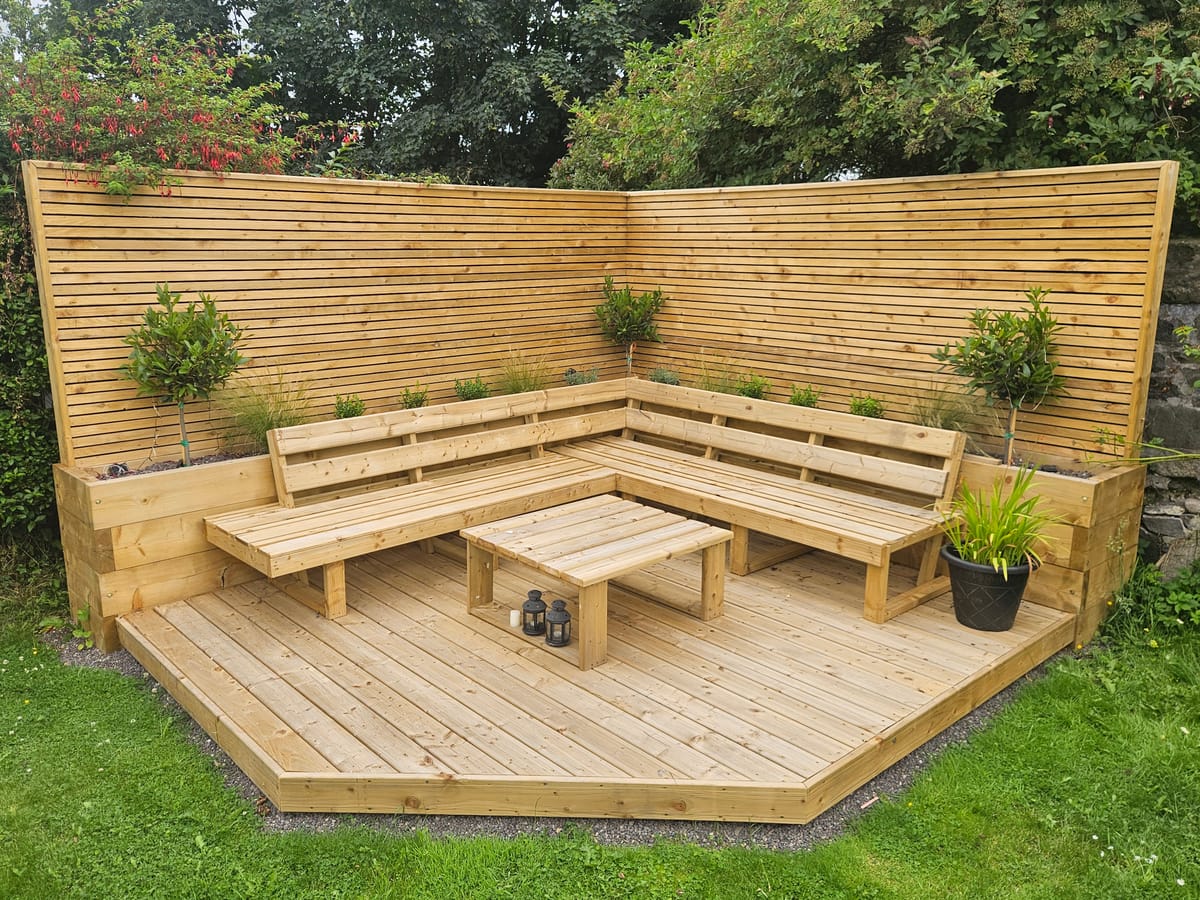
If you’re pricing a timber deck for an Irish garden, you’ll hit the same fork in the road everyone does: pay less now for pressure-treated softwood, or pay more for hardwood and hope it earns the difference back over the years. It’s a fair question and the answer isn’t the same for every garden. We build both across Louth, so here’s the honest comparison, what each one actually costs, how long it really lasts in our weather, and which we’d point you towards for your spot.
Call Seamus on 085 168 5170 for a free quote or message us on WhatsApp.
If you’ve already settled on real wood over composite and just want the build-quality detail, our timber decking page covers how we put a deck together. This guide is about the choice before that one: which timber.
The Short Version
Pressure-treated softwood is the cheaper, lighter, easier-to-work timber. It’s pine or spruce that’s had preservative forced into it under pressure to slow down decay. Hardwood, here that usually means yellow balau, iroko or oak, is denser, naturally durable and a good bit dearer. It needs no chemical treatment because the wood itself resists rot and insects.
The trade-off in one line: softwood costs less upfront and needs more upkeep, hardwood costs more upfront and needs less. Everything below is the detail behind that.
Lifespan: How Long Each One Lasts in Irish Weather
This is the number people care about, and it’s worth being straight on it. A well-built pressure-treated softwood deck typically gives you somewhere in the region of 10 to 20 years here if it’s kept clean and re-coated, while Irish timber suppliers put quality hardwoods like balau at up to 25 years and, in some cases, considerably longer.
But notice how wide those ranges are. The difference between a softwood deck lasting 10 years and lasting 20 isn’t the timber, it’s whether it was built to shed water. The UK’s Timber Decking and Cladding Association is clear that structural timbers, the posts, beams and joists holding the deck up, should be pressure-treated to Use Class 4, the grade rated for ground contact and permanent wetting. Boards above the ground should be at least Use Class 3. Get the treatment grade wrong on the frame and even the best boards won’t save a deck.
So hardwood does last longer, no argument. But a properly built softwood deck outlasts a badly built hardwood one every time. The build is the lever, the timber is the trim.
Cost: The Real Gap
We don’t quote flat figures online because no two Louth gardens are the same, and we won’t invent a price for you. What we can tell you honestly is the shape of the gap.
Pressure-treated softwood is the budget-friendly start. It’s why most people who want real wood begin here, and for a larger area it keeps the upfront cost sensible. Hardwood sits well above it, often a significant step up per square metre for the boards alone, and it’s slower and harder to fit because the timber is so dense, which adds to labour.
The way to think about it isn’t just the day-one price. Softwood asks for a clean and a fresh protective coat every year or two to hold its colour and slow weathering. Hardwood asks for far less, an occasional oil if you want to keep the rich tone, or nothing if you’re happy to let it silver to a soft grey. Over fifteen years that upkeep difference closes some of the gap. For the actual ranges we work to, our decking cost guide lays them out.
Treatment, Maintenance and Rot
Here’s where the two timbers genuinely differ in how they survive an Irish winter.
Softwoods like pine and spruce aren’t naturally very durable, so they’re pressure-treated: preservative is driven deep into the wood to make it resist fungal decay and insects. That treatment is what lets a softwood deck cope outdoors at all. The catch is that sawing a treated board exposes an untreated core at the cut end, which is exactly where damp gets in if it’s left bare. On every job we seal those cut ends, because that’s the spot a softwood deck rots first.
Hardwoods don’t need the chemical treatment. Balau, iroko and oak are dense, tight-grained timbers that are naturally resistant to rot, fungus and insect attack, which is why they last longer with less fuss. They’re not immune, though. No timber is. Any deck left with water pooling on it or a frame that can’t breathe will eventually suffer, hardwood included.
That’s the part that matters most in our climate. Met Éireann logged 1,338.7mm of rain across Ireland in 2025, one of the wettest years on record, and a Louth garden gets plenty of that. Whichever timber you pick, the deck only lasts if the frame is ventilated and free-draining so water runs off instead of soaking in. A chartered surveyor made the same point in the Irish Times, advising that decking be laid with a slight fall so rainwater drains along the grooves rather than standing on it. We build to that on every deck, hardwood or softwood. The timber buys you the years; the build is what protects them.
Which We’d Recommend for a Louth Garden
There’s no single right answer, and we’ll always tell you which we’d choose for your garden once we’ve seen it. But as a rule of thumb:
- Choose pressure-treated softwood if you want real wood at the lower upfront cost, you’re covering a larger area, and you don’t mind a wash and a re-coat every year or two. It’s a sound, good-value deck when it’s built properly.
- Choose hardwood if you want the richest natural look and the longest life, you’d rather do less upkeep, and the higher upfront cost suits you. Balau in particular is a workhorse in our weather.
- Consider composite instead if low upkeep is your top priority and you’d happily trade the natural timber look for a board that needs little more than a wash. We cover where that lands in our look at timber versus composite for Irish gardens.
Either timber, built the way we build it, gives you a deck that earns its place in the garden. The mistake is buying on price alone and skipping the frame and the sealing that decide how long it lasts.
We’re a Dundalk father-and-son team building timber decks across County Louth, in Blackrock, Carlingford, Ardee, Cooley and beyond, and we’ve fitted enough of both to give you a straight steer on which suits your garden and budget. Call Seamus on 085 168 5170 or message us on WhatsApp and he’ll help you weigh hardwood against softwood for your spot.