
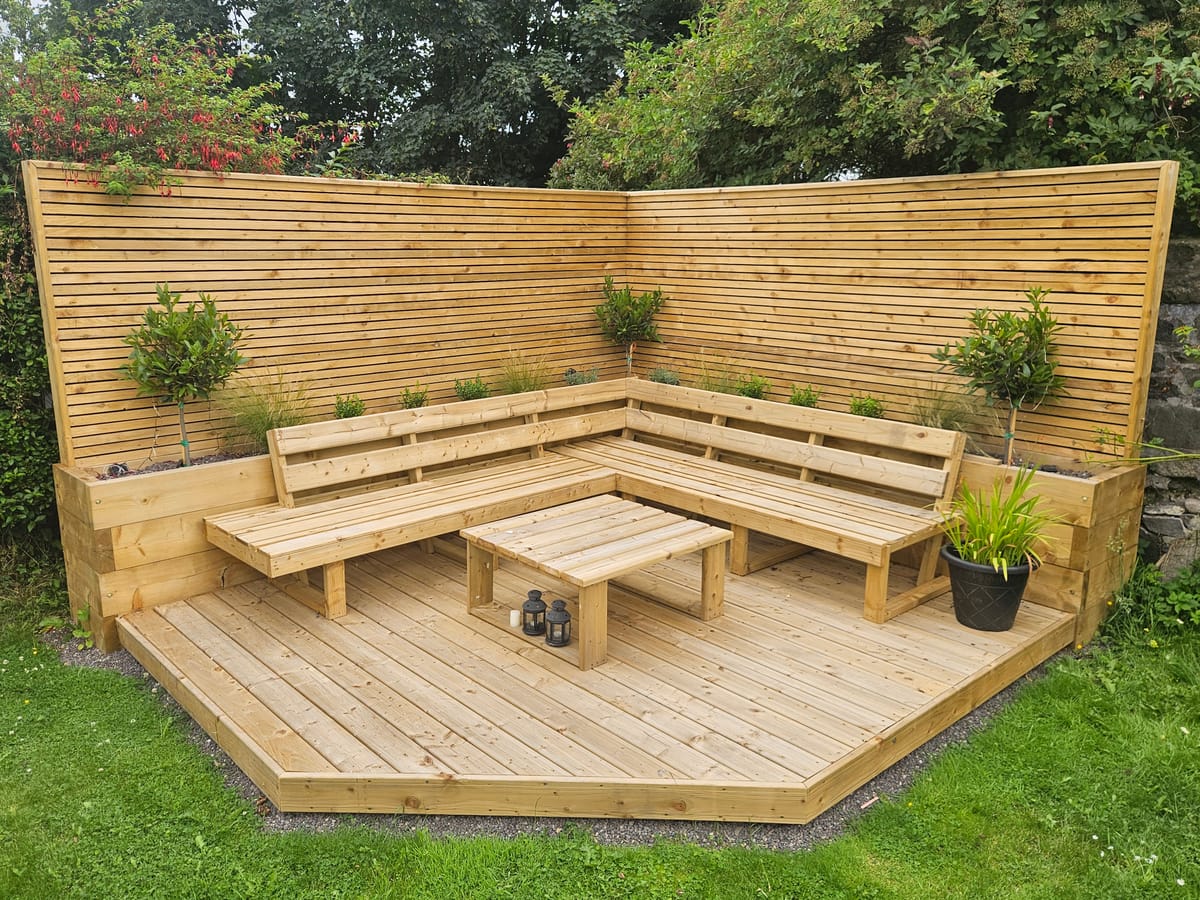
It’s the question every homeowner wants answered before they ring a single tradesman: what is this actually going to cost me? Timber decking has a reputation for being the affordable option, and it usually is, but the honest answer is that “timber decking” covers everything from a cheap softwood deck that greys in two winters to a dense hardwood one built to outlast the house. The price gap between those is real. So here is a straight 2026 guide to what timber decking costs in Ireland, what softwood and hardwood actually run to per square metre, and the things that quietly move the number on a County Louth garden. We build timber decking across Dundalk and Louth every season, so these are the figures we work to, not numbers off a brochure.
Softwood vs Hardwood: The Real Per-Square-Metre Ranges
The honest way to compare decking quotes is per square metre, supplied and fitted, including the subframe. That’s the number that lets you put two tradesmen side by side without getting fooled by one who’s left the frame out.
For pressure-treated softwood, the most common choice in Irish gardens, you’re typically looking at from around €80 to €120 per square metre supplied and fitted. That lines up with the independent Tradesmen.ie decking price surveys, where Irish contractors quoted softwood decking at roughly €100 per square metre for supply and install. Hardwood, the likes of iroko, sits higher again, generally from about €120 to €180 per square metre, because the timber itself costs more and it’s denser and harder to work.
To put that in a real shape: a standard 6m by 6m softwood deck, which is 36 square metres, has come in around the €3,000 mark for a level garden in those same Irish surveys, with the timber and the labour making up the bulk of it. Hardwood over the same footprint runs noticeably dearer.
So the rule of thumb is simple. Softwood is the budget-friendly start, hardwood is the premium long-game, and both are sound if they’re built right.
What Actually Drives the Price
The per-square-metre rate is only the headline. Here’s what moves the final figure on a real Louth job, and none of it is padding.
- Access. A flat garden you can walk timber straight into is cheaper than a deck behind a terraced house in Dundalk town where every board comes through the hall.
- Ground and levels. A sloped or uneven site needs more frame, longer posts and bracing, which adds time and material. A raised deck is more work than a ground-level one.
- Steps and handrails. These are costed separately for good reason. A step run can add a few hundred euro depending on width and material, and balustrades add more again.
- Old deck removal. If there’s a rotten deck to rip out and skip, that’s real work. We build it into our quote so you’re not landed with it after.
- The timber grade. Properly pressure-treated, ground-rated posts cost more than the cheap stuff, and they’re the difference between a deck that lasts and one that doesn’t.
That last point matters more than people think, which brings us to the part of the price you can’t see.
Why the Cheapest Quote Is Rarely the Cheapest Deck
Here’s the trap. Two quotes land, one is a few hundred euro cheaper, and it’s tempting to take it. But timber doesn’t fail because it’s timber. It fails because of how it was built.
A deck thrown together with under-treated boards, no air gap under it, bare cut ends soaking up damp and no fall to drain the rain was always going to go grey and soft. We’ve ripped out plenty of those across Blackrock and Castlebellingham. The wood didn’t let anyone down; the build did. Cut ends are where rot starts, because that’s the raw end-grain that drinks water, so we seal every one. The subframe is ventilated and drained so air moves and water runs off instead of sitting. The posts are ground-rated where they meet the soil.
None of that shows up in a glossy photo, and it’s exactly where a too-cheap quote has quietly saved itself money. You don’t see it until the second winter. A properly built timber deck is low-maintenance, not no-maintenance, and it’s built to last because the damp can’t get a foothold. That’s the value you’re actually paying for.
If you want to weigh the lifetime cost against the alternative, our look at timber versus composite decking in Ireland lays out where each one earns its keep.
What It Costs to Build Yours in Louth
We don’t put a flat price on the website, and we never will, because it would be a guess. A small ground-level softwood deck in Ardee and a raised hardwood one with steps and a balustrade in Carlingford are different jobs with different numbers, and pretending otherwise just leads to nasty surprises.
What we do instead is come out, look at the garden, talk through softwood against hardwood for your spot, and hand you a fixed, written, itemised quote. The timber, the frame, the steps, the cleanup and the old-deck removal, all listed, so you can see exactly what you’re paying for and compare it honestly against anyone else. The supply-and-fit ranges above are the figures we work to; the visit is what turns them into a real price.
We’re a Dundalk father-and-son team building timber and composite decks right across County Louth, from Cooley and Carlingford down to Ardee, and we’ve seen enough cut-price decks fail to know exactly where the money should go. Call Seamus on 085 168 5170 or message us on WhatsApp and he’ll give you an honest steer on what timber decking would cost for your garden.