
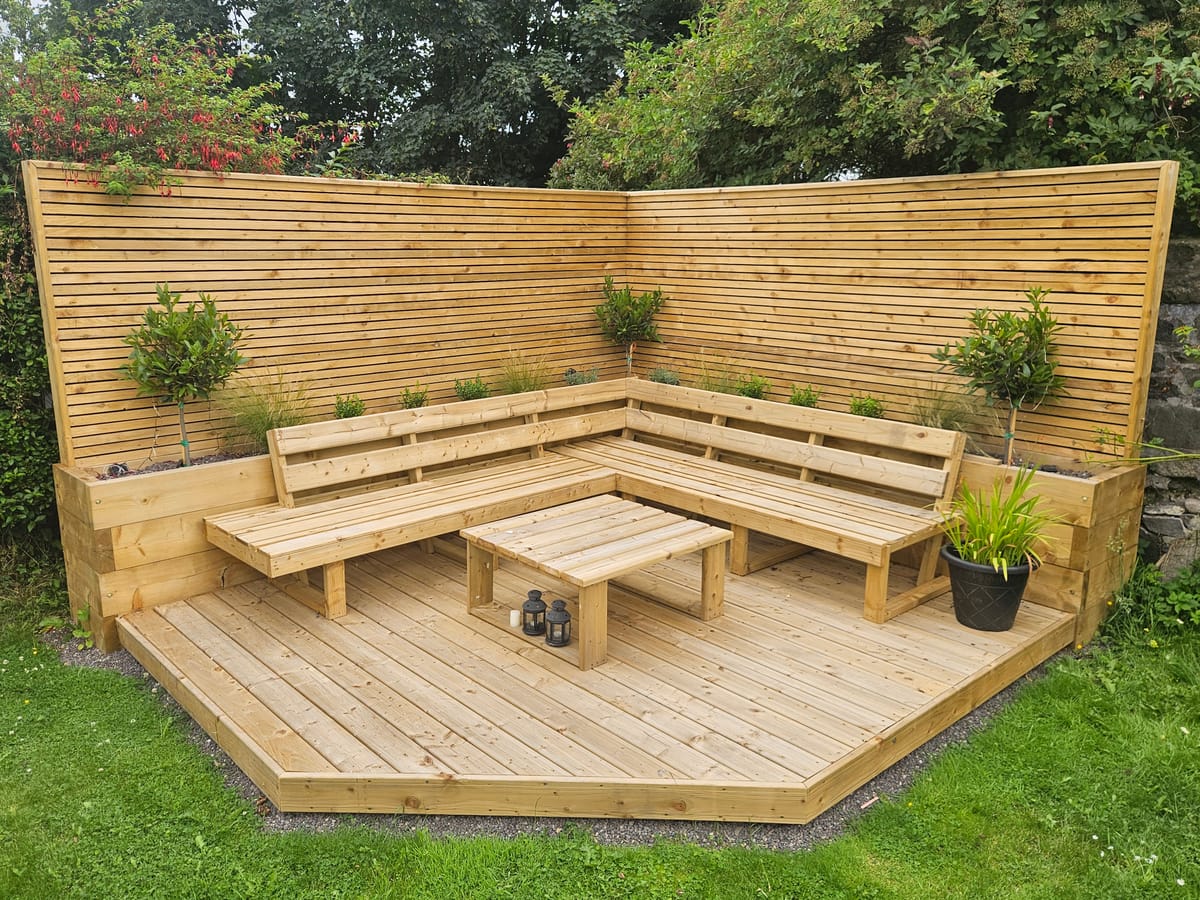
It is the first question nearly everyone asks before they spend money on real wood, and a fair one. We have all heard about the deck that went grey, soft and slippery inside a few winters, and nobody wants to pay good money for that. So how long does timber decking actually last in Ireland, in our damp, mild, rain-most-weeks weather here in Louth? The honest answer is a wide range, anywhere from under ten years to over twenty, and where your deck lands on that scale has surprisingly little to do with the timber itself. It comes down to how it is built and how it is looked after. Here is the straight version.
Call Seamus on 085 168 5170 for a free quote or message us on WhatsApp.
The Honest Numbers
Let’s start with the figures the trade actually works to. For pressure-treated softwood, the kind of timber most decks in Ireland are built from, you are realistically looking at somewhere around 15 to 20 years from a deck that is built well and maintained. That is the band reputable suppliers and trade bodies quote, and it is the band we work to here. The Timber Decking and Cladding Association, the UK and Ireland trade body for decking, points homeowners towards products carrying a performance warranty of 15 to 25 years and stresses that a timber deck should be a long-lasting structure when it is specified and looked after properly.
Hardwood is a different story again. A dense, naturally durable hardwood like balau or ipe is far slower to take on water and can run for decades, often with lighter upkeep than softwood needs. It costs more upfront, sometimes a good deal more, but if you want maximum life from real wood, hardwood is where it is. We talk through the trade-off in hardwood versus softwood decking if you are weighing the two.
The part worth holding onto is this: those numbers are not a property of the wood you buy. They are the best case for timber that is built and finished correctly. The same softwood, built badly, can be rotten in a handful of winters. If you want the full picture on our materials, our timber decking page lays out how we spec and build them.
What Decides Where Your Deck Lands
Two decks built from identical timber, fifty metres apart in the same Dundalk estate, can have completely different lifespans. The difference is almost always in these few things.
The subframe. This is the part you never see and the part that decides everything. Timber needs air moving under and around it to dry out between downpours, and it needs water to run away rather than pool. The Timber Decking and Cladding Association is clear that any timber in ground contact must be pressure-treated to Use Class 4, the ground-contact standard, and that exterior structural timbers should meet that grade. Build the frame on bare wet soil with no ventilation and no drainage and you have built a sponge. Lift it, ventilate it and let it drain and the same timber lasts for years.
Sealed cut ends. Every time a board or joist is cut, you expose raw end grain, and end grain drinks water far faster than the face of the timber. The factory treatment doesn’t reach those fresh cuts. Leaving them bare is one of the most common reasons a deck fails early, which is why every cut end on our builds gets sealed with end-grain preservative before it goes down. It is a small step that buys you years.
A fall for run-off. Standing water is the enemy of timber. A chartered building surveyor writing in the Irish Times recommended that new decking be set on a slight slope so rainwater drains off along the grooves rather than sitting on the boards. In our climate, where rain falls most weeks of the year, that single detail separates a deck that lasts from one that quietly rots from the surface down.
The maintenance. Even a perfectly built softwood deck needs you to play your part: a wash to keep algae and grime off, and a fresh coat of oil or stain every year or two to keep water out of the timber. Skip it and the protective coat breaks down, the grain opens up and the clock speeds up.
Why Irish Weather Is Hard on Timber
None of this is timber’s fault. It is just that our weather pushes harder on the weak points than a drier climate would. Ireland’s mild, wet maritime conditions mean a deck rarely gets a long dry spell to fully dry out, so any trapped damp lingers. Met Éireann notes that recent years have brought more frequent heavy rainfall events, and wetter winters are part of the picture going forward. More water, landing more often, on a surface that does not drain, is exactly the condition that finds a badly built deck.
Out along the Cooley coast, in Carlingford and Greenore, there is the added factor of salt-laden air, which is tough on fixings and finishes alike. It is not a reason to avoid timber near the water, but it is a reason to build with the right corrosion-resistant fixings and to stay on top of the re-coating. We cover that exposed-site detail in our note on coastal decking in Louth.
The flip side is the encouraging bit. We have lifted out decks barely six years old that were beyond saving, and we have seen timber decks past the twenty-year mark still solid because someone built them right and kept after them. The weather did not decide which was which. The build did.
Getting the Full Life Out of Your Deck
If you want a timber deck to reach the top of its range rather than the bottom, the recipe is not complicated:
- Build on a ventilated, free-draining subframe with an air gap and ground-rated treated timber where it meets the ground
- Seal every cut end with preservative as it goes down, not after
- Lay the boards with a slight fall so rain runs off instead of sitting
- Use corrosion-resistant fixings, more so anywhere near the coast
- Keep up the wash and re-coat, roughly yearly, to keep water out of the wood
Do the first four and you have a low-maintenance deck built to last. Do the fifth and you keep it that way. That is the whole game. We build timber decks across Dundalk, Blackrock, Ardee, Castlebellingham and the Cooley peninsula to exactly that standard, because a deck that needs ripping out in eight years is no good to anyone.
We are a Dundalk father-and-son team building timber and composite decks across County Louth, and we have pulled out enough decks that died young to know exactly what keeps the good ones going. Call Seamus on 085 168 5170 or message us on WhatsApp and he will give you a straight answer on what your garden needs and how long it should last.